
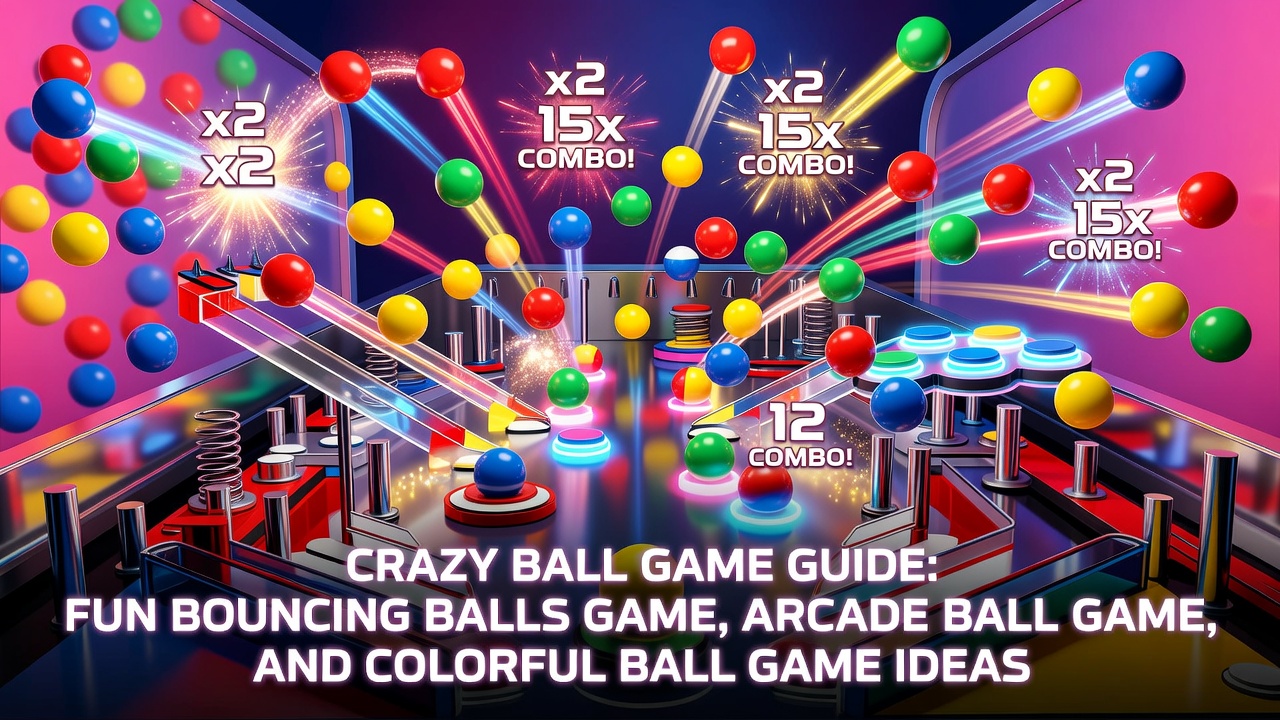
A ball bouncing at a forty-five degree angle off a wall follows physics that has barely changed since Newton wrote it down, yet game designers keep finding new ways to make that simple motion feel unpredictable and thrilling. That tension between predictable physics and chaotic gameplay is exactly what makes a crazy ball game so addictive. The genre has quietly become one of the most reliable categories in casual gaming, sitting somewhere between puzzle logic and reflex-based arcade action.
What separates a forgettable bouncing balls game from one players return to for weeks is rarely the graphics. It is the pacing, the way obstacles escalate, and how quickly a player's own mistakes turn into visible, satisfying chaos on screen. Developers who understand this build levels that reward timing over luck. If you want to see how these principles come together in a polished, colorful format, the website offers a practical example of the genre executed with attention to both visual clarity and mechanical fairness. Studying a well-built title like that reveals patterns worth applying to any ball-based project or simply worth recognizing as a player.
This guide breaks down the mechanics, design choices, and player psychology behind the entire family of bouncing and arcade ball titles, so whether you're evaluating games to play or thinking about building one, you'll understand exactly what makes the format work.
What Makes a Crazy Ball Game Different From Ordinary Arcade Titles
The Physics-Chaos Balance
Most arcade ball games rely on a fixed set of physical rules: gravity, momentum, friction, and collision response. A crazy ball game deliberately bends one or two of these rules per level rather than all at once. A sudden gravity flip or a wall that reverses momentum instead of absorbing it creates surprise without making the game feel broken. This restraint is what separates well-designed chaos from random frustration.
Why Unpredictability Keeps Players Engaged
Predictable games become boring within minutes. Unpredictable games without any underlying logic become frustrating within minutes. The sweet spot lives in between: rules that are consistent within a level but new between levels. Players build a mental model, test it, get surprised, then adjust. That loop of expectation and correction is the core engagement mechanic across nearly every successful bouncing balls game.
Common Mechanics That Define the Genre
- Bounce-based movement with limited direct control
- Obstacles that punish overcorrection more than undercorrection
- Escalating speed or complexity tied to score or time
- Visual feedback tied directly to velocity and impact
The Appeal of Bouncing Balls Game Mechanics
Simple Controls, Deep Skill Ceiling
Bouncing mechanics are easy to learn because they mimic something everyone has experienced physically. A ball dropped from a height bounces lower each time; a ball hit at an angle deflects predictably. Games exploit that intuition, then layer skill-based timing on top of it. This is why a five-year-old and a competitive gamer can both enjoy the same core loop at different levels of mastery.
Momentum as a Design Tool
Momentum carries consequences forward. A player who enters a section too fast inherits that speed into the next obstacle, whether they're ready or not. Designers use this to create tension without adding new mechanics - the punishment for a mistake is built into the physics itself rather than scripted separately.
Why Repetition Doesn't Feel Repetitive
Because outcomes vary slightly with each attempt due to timing precision, no two runs feel identical even on the same level layout. That micro-variation is what allows bouncing balls game formats to sustain replay value far longer than static puzzle formats.
Exploring Fun Ball Games Across Genres
Puzzle-Based Ball Games
These titles slow the pace down, asking players to plan trajectories before releasing the ball rather than react in real time. Success depends on spatial reasoning rather than reflexes.
Reflex and Action-Based Ball Games
Here, speed dominates. Levels are short, failure is immediate, and mastery comes from muscle memory built over dozens of attempts. This subcategory overlaps heavily with classic arcade sensibilities.
Multiplayer and Competitive Formats
Adding a second player transforms fun ball games from solo skill tests into direct competition. Shared boards, split-screen chaos, or turn-based scoring all change how players approach risk - a move that's safe in solo play might be reckless when an opponent is watching your score in real time.
Casual and Idle-Style Ball Games
Lower-stakes formats let players bounce balls with minimal failure states, appealing to those who want a relaxing loop rather than a challenge. These often lean into visual reward over mechanical depth.
Arcade Ball Game Design: What Keeps Players Coming Back
Score Systems and Immediate Feedback
Arcade design has always relied on instant, visible feedback - points appearing the moment a ball hits a target, combo multipliers stacking on screen. This immediacy trains players to associate specific actions with specific rewards almost instantly, reinforcing the behavior the designer wants repeated.
Difficulty Curves That Respect Player Time
A well-tuned arcade ball game increases difficulty in small, digestible steps rather than sudden spikes. Early levels teach mechanics implicitly through level layout rather than tutorials, which keeps the pacing tight and avoids breaking immersion with instructional text.
Sound and Visual Cues Tied to Physics
The satisfying "clack" of a ball hitting a peg, or the flash of light on impact, isn't decoration. These cues confirm to the player that their timing was correct before the score even updates, creating a faster feedback loop than visuals alone could provide.
Colorful Ball Game Aesthetics and Player Psychology
Why Color Coding Improves Playability
A colorful ball game isn't just visually appealing - color coding communicates function. A red ball might mean danger, a gold ball might mean bonus points. This lets players process information faster than they could through text or numbers alone, which matters enormously in fast-paced formats.
Contrast and Readability Under Motion
Bright, saturated palettes work well in ball games specifically because objects move quickly and players need to track them at a glance. High contrast between the ball, the background, and the obstacles reduces the cognitive load of simply following the action.
Emotional Response to Bright, Dynamic Visuals
Color also shapes mood. Vibrant, high-energy palettes signal excitement and reward, while muted tones typically appear in more strategic or slower-paced ball puzzles. Matching palette to pacing is a subtle but consistent pattern across the genre.
Choosing the Right Ball Game for Your Play Style
If You Want Fast, Reflex-Driven Action
Look for titles with short level lengths, immediate restarts, and minimal menu friction. These favor players who want quick sessions with high repeatability.
If You Prefer Strategic, Planned Movement
Puzzle-oriented ball games with trajectory previews or turn-based mechanics suit players who enjoy thinking several moves ahead rather than reacting in real time.
If You're Playing With Friends or Family
Multiplayer-focused formats, especially those with simple shared controls, tend to translate better to group settings than deeply mechanical single-player experiences.
Frequently Asked Questions
What skills does playing a crazy ball game actually improve?
These games sharpen reaction time, spatial judgment, and pattern recognition. Because levels often shift their rules slightly, players also build adaptability - the ability to update a mental model quickly when conditions change.
Are bouncing balls games suitable for younger players?
Most are, since the core mechanic relies on intuitive physics rather than complex controls. Parents should still check difficulty settings, as faster-paced levels can be frustrating for very young children still developing fine motor timing.
Why do colorful ball games feel more engaging than minimalist ones?
Bright color coding speeds up decision-making by letting players identify hazards, bonuses, or targets instantly rather than reading labels. This visual shorthand keeps fast-paced gameplay from feeling overwhelming.
What's the difference between an arcade ball game and a puzzle ball game?
Arcade formats prioritize speed, reflexes, and immediate scoring feedback. Puzzle formats slow the pace down, asking players to plan a trajectory or sequence before acting, rewarding foresight over quick reaction.
How do designers keep fun ball games from becoming repetitive?
By introducing small rule variations between levels rather than overhauling mechanics entirely. Consistent core physics combined with shifting obstacles keeps the experience familiar yet fresh across many play sessions.
Can these games be genuinely competitive, or are they mostly casual?
Both. Casual versions exist for relaxed play, but many titles include leaderboards, timed challenges, or multiplayer modes that reward precision and consistency, giving them real competitive depth for players who seek it.