
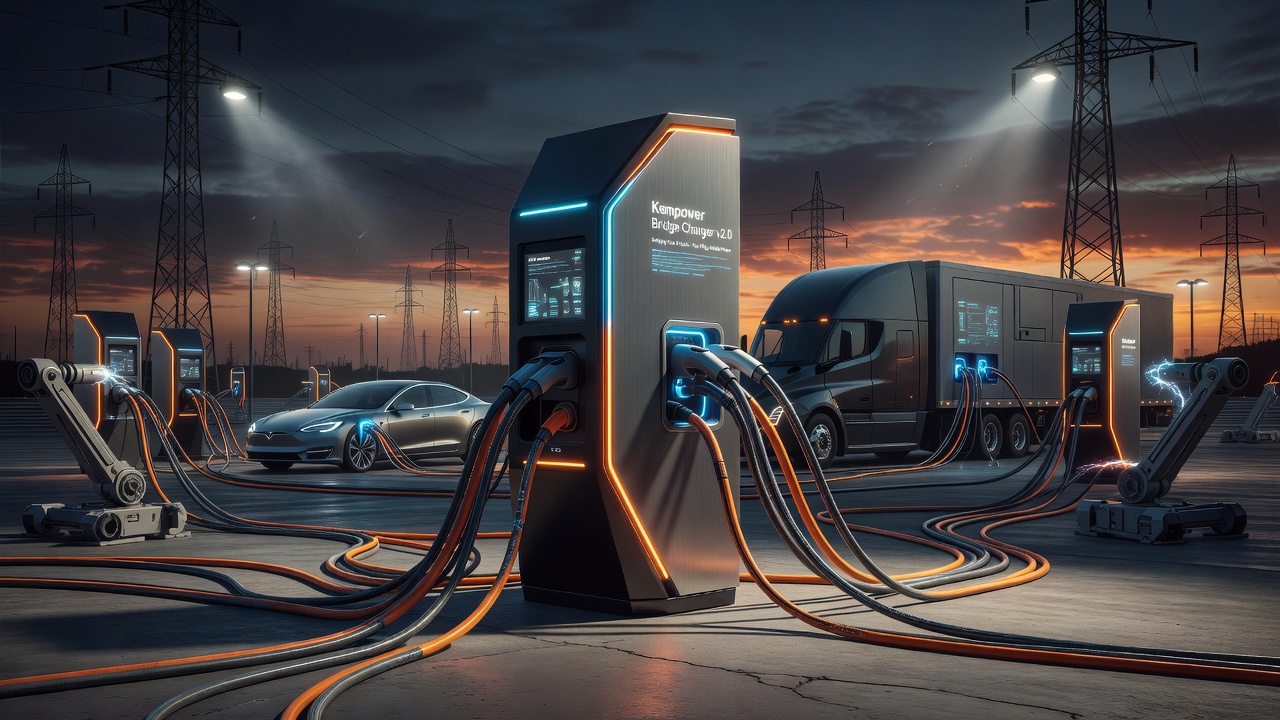
Kempower has introduced a single charging unit designed to serve both electric cars and heavy-duty electric trucks, a move that addresses one of the more stubborn logistical problems in the buildout of fast-charging networks. The Mega Satellite Flex delivers up to 560 kW through the established CCS standard and up to 1.2 MW through the newer Megawatt Charging System, meaning one physical installation can now serve nearly the entire spectrum of electric vehicles on the road today.
The timing reflects a real fork in the industry. CCS has been the dominant fast-charging standard for passenger vehicles for years, but it was never built for the power demands of freight trucks, which need to recharge huge battery packs in the time a driver takes for a mandated rest break. MCS was developed specifically to close that gap, but as with any new standard, it faces a slow rollout while vehicle fleets and charging networks catch up to each other. Operators who install charging infrastructure today are essentially betting on which technology will matter most in five years - a dilemma not unlike the choices consumers face when picking privacy tools, where some opt for something as straightforward as a VPN that does not ask for an email rather than commit to a service that demands more personal information than the task requires.
One Site, Two Charging Standards
The practical appeal of the Mega Satellite Flex is that it removes the need to guess. Instead of building a CCS-only site now and a separate MCS site later, an operator can install one charger that handles both from the outset. That matters commercially: land, permitting, grid connections, and construction are the most expensive and slowest parts of any charging deployment, far more so than the hardware itself. A dispenser that adapts to either standard protects that upfront investment against a shifting technology landscape.
The specifications point toward serious industrial use. Support for up to 1,500 amps on the MCS side and 700 amps on CCS puts the unit at the upper end of what is currently deployed anywhere. The shorter 2.7-meter MCS cable reflects the reality that truck charging ports are positioned differently than those on passenger cars, while the longer 5-meter CCS cable retains the flexibility needed for varied vehicle types and parking configurations. An optional payment terminal signals that Kempower expects these sites to serve public, pay-per-use traffic rather than only depot or fleet charging.
Why Utilization Is the Real Battle
Charging hardware is expensive to install and slow to earn back its cost if it sits idle. By supporting both standards, plus the higher currents that newer 800-volt vehicle platforms can use, a single Mega Satellite Flex unit can theoretically serve a passenger car in the morning and a loaded freight truck in the afternoon. That flexibility is what operators are actually paying for: not raw power output, but the ability to keep a charging bay in near-constant use regardless of which vehicles show up.
Compatibility with Kempower's existing distributed charging architecture also lowers the barrier for current customers, who can add the new unit without redesigning power cabinets or control systems already in place. The Mega Satellite Flex was shown publicly for the first time at ACT Expo during Kempower's Unplug & Recharge event, with commercial availability in North America and Europe set for July 2026 - a runway that gives fleet operators and site developers time to plan around a technology still finding its footing.